- Rosamund Community Garden
- Posts
- Rosamund Garden News

Dear all,
Spring has arrived at Rosamund, bringing colour, collaboration and exciting steps forward for the garden and Hub.
📅EVENTS AT THE GARDEN
🌱Saturday, 25th April, 9:45 am to 12:00 pm - Introduction to Gardening Workshop with Lynne and Clare. Session 2 - Sowing Seeds Next Steps - potting on, watering, feeding, companion planting and a guided garden tour. Take home a potted seedling and booklet » TICKETS
🍂Saturday, 2nd May, 2:00 pm to 3:00 pm - Family Nature Connection session with Jane, a perfect event for families to slow down, explore, and enjoy meaningful time together outdoors » RESERVE A SPOT
🌿Sunday, 3rd May, 10:00 am to 1:00 pm - Natural Building with Clay with Helen
🏗️Wednesday, May 13th - Galliford Try - Corporate Volunteering Day (closed group)
🌍EVENTS AT ZERO GUILDFORD » CLICK
🐌GARDEN UPDATE
This March was a momentous month for the Rosamund community, as we officially became part of the Zero Carbon Guildford team when they merged with GEF (our umbrella group). The impact of this will mean greater reach for our events, collaboration on workshops at the garden, and support with funding streams to advance our work and project dreams.
We feel very lucky to be part of this proactive and motivated group of people and would like to thank Helen Harris and the Zero team for making this happen.
In the garden
Spring has sprung, and it seems incredible that we are now watering the polytunnels to keep the salads succulent and maintain healthy soil ready for the next crops.
Kate has been busy turning the compost, and we now have some wonderful mulch for the tunnels once the salads have finished.

The orientals are starting to flower, so now is the time to harvest salads before they become too peppery. The purslane (miner’s lettuce) has been a big success. Much loved by all ages for its juicy, mild leaves, it has self-sown brilliantly in poly 1. The flowers are all edible and make a pretty addition to your plate.

We’ve been busy sowing seeds in poly 2, and this warmer weather has helped with germination.
Lisa had a successful trip to the Guildford seed swap and brought back some interesting seeds for us to try out.
Ann has been busy sowing tomatoes in her greenhouse and will be getting on with cucumbers and squash next month.

The raised beds are full of chard and spinach, and the garlic is looking healthy. We’ve inter-sown with carrots, so we’ll see how this goes. (The onion family are great companions for carrots, as they confuse carrot fly with their strong scent.)
Elsewhere, the forest garden is starting to come to life. The carpet layer of mint and wild strawberries is spreading nicely, and we’ve been sharing plants among volunteers and visitors to take home. The perennial broccoli is full of edible white flowering tips, and the rhubarb is going great guns.

The fruit cage is bursting forth, and the currants already have big fronds of flowers, promising another good crop. This year, we will grow some kales and broccoli alongside the fruit, with the advantage of ready-made bird-proofing to protect the plants. (Pigeons just love brassicas.)
This year we’re planting more herbs and flowers around the garden. Ann successfully sowed lots of mullein last autumn, and we’ve planted it around the fruit trees and in the forest garden. Mullein is a native plant that grows a rosette of large, soft leaves in its first year, followed by tall yellow flower spires in the second. The leaves are a valuable herb for chest complaints and were also used as natural loo paper. It can also be made into a soothing skin cream, is excellent for pollinators and is drought-resistant. We’ll be saving the seed to share next year, as it ticks so many boxes.
Erin and Skye have been sowing their dye seeds for this year, including coreopsis, Hopi sunflowers and marigolds. Erin is planning to run some dye workshops at the garden following the success of last year’s brilliant day.

The Hub
We had our first corporate group last month, from Motion in Guildford. They had a lovely time learning to wattle and daub and had a go at lime pointing on the stone plinths. It was a sunny day and they had great fun getting stuck into the mud.

We are nearly there now, with just the tops of the walls to daub before we start applying the render.
We will be running a couple of sessions, starting with Helen’s on 3 May, so if you fancy having a go and helping us finish the Hub, do get in touch.
In June, we will be running a rendering workshop, where we’ll explore natural rendering techniques. I’m also hoping we can get children (and adults) involved in creating clay sculptures to add to the walls.
We received a donation from the remaining GEF funds, which means we can now move forward with our long-awaited solar power. We’ve had lots of advice and now need to take the plunge and choose a system. Eek.
Malcolm has nearly completed the bamboo gutters on the Hub, and they are working brilliantly, emptying into our wooden barrels.
DofE
The Bronze DofE students successfully completed their volunteering at the garden and had lots of fun baking, mulching and creating bug hotels. Two of the students have decided to stay on for another three months, which is great news.


Thomas has completed his Silver award and created a brilliant water filter for his DT GCSE project, inspired by the debris in our gutters. We are very glad to welcome Thomas, Matt and Amy back for their Gold awards next September.
RGS + GHS
The local secondary schools have now finished their volunteering for the year, after coming up over the winter and making a huge difference each week. They enjoyed weaving fence panels with the willow they coppiced and planting new wands for our playhouse structure.
We look forward to welcoming them back in September.
🐦⬛FEATHERED FRIENDS AT ROSAMUND
There’s something quietly magical about noticing who’s visiting the garden when we’re not looking. From fleeting flashes of wings to familiar daily visitors, our birdlife tells its own story of the seasons.
Alan’s latest bird report captures the sightings from the first part of the year, a gentle snapshot of who’s been popping by and making themselves at home.
Have you spotted any of these in the garden, or seen something new?
CLICK HERE to read on to explore the latest sightings and share what you’ve seen too.
👩🏻🌾APRIL JOBS AT THE GARDEN
Water seedlings in poly 2 when needed
Water between rows in poly 2 when dry
Harvest salads and leaves and broccoli to share
Sow seed in modules (check packet for planting times)
Water the new willow around the mud kitchen and the Tree-bog
🌿PLANT OF THE MONTH - Cowslip (Primula veris)
by Helen Harris
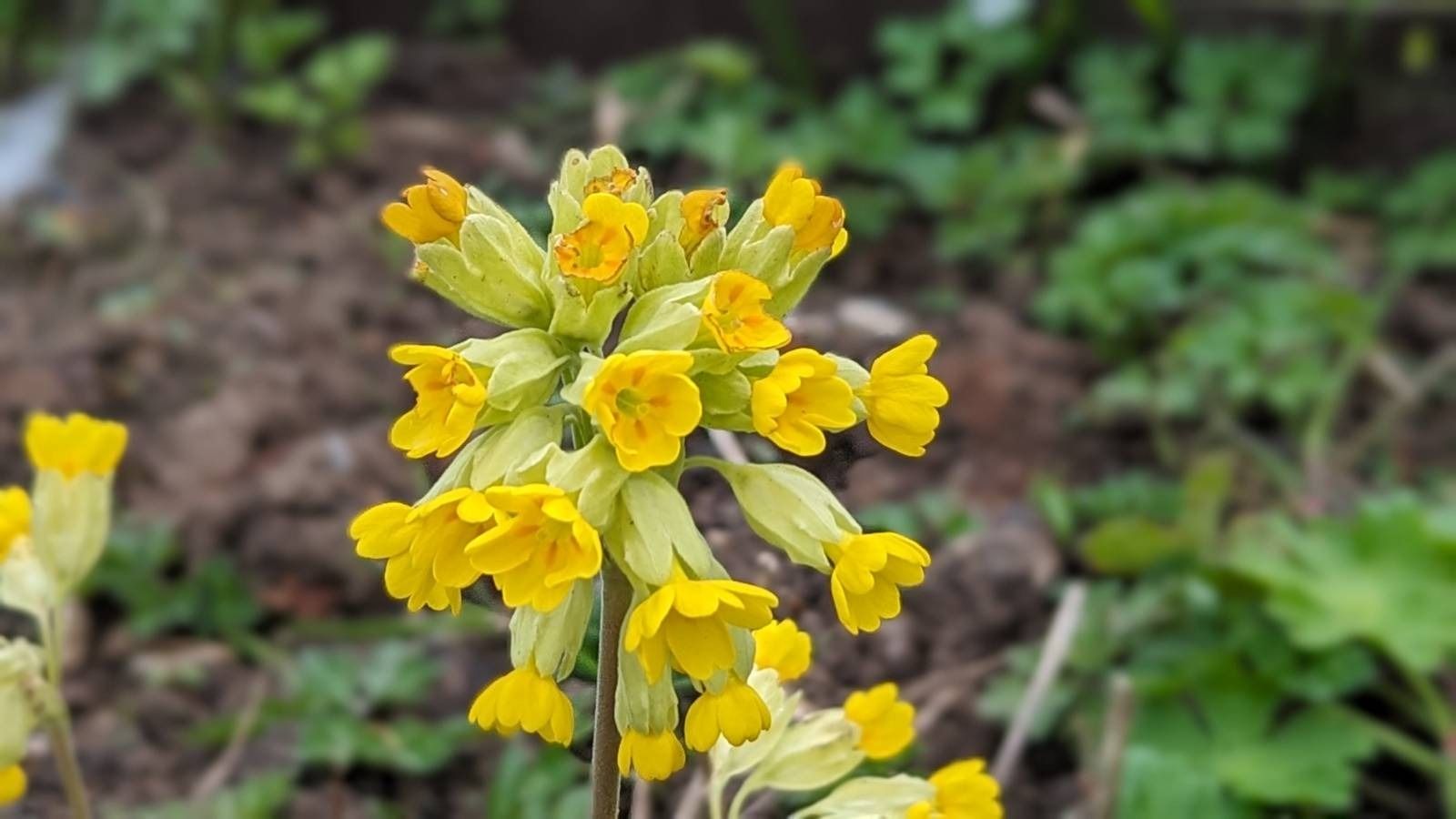
Common name: Cowslip
Scientific name: Primula veris
Family: Primroses
Origin: native
Flowering season: April to May
Habitat: dry chalky soils, grassland, woodland, hedgerows
We have a beautiful and growing little patch of self-seeded cowslips at Rosamund Garden, under the crabapple between poly 1 and the wildlife pond. They are now in full flower and will hopefully set seed and spread further.
An endangered wildflower
Formerly a common plant of traditional hay meadows, ancient woodlands and hedgerows, the loss of these habitats has caused a major decline in cowslip’s populations between 1930 and 1980, mainly due to the ploughing of old grasslands and the extension of the use of chemical herbicides.
Nowadays, fields coloured bright yellow with cowslips are quite a rare sight. Fortunately, it is now showing signs of recovery and is returning to unsprayed verges and village greens as well as colonising the banks of new roads. Masses have reappeared in Hertfordshire where grazing pressures have eased.
Value to wildlife
Cowslips are important for wildlife because their flowers are an early source of nectar for various insects including bees, beetles and butterflies such as the brimstone. Cowslip is also a food plant for the rare Duke of Burgundy butterfly.
Folklore and symbolism
Cowslips were traditionally used in May Day garlands but also for other celebrations, such as weddings. The name ‘Cowslip’ is actually a distorted pronunciation of ‘cow slop’, so named because the flowers are associated with cow pat in meadows and fields. Cowslips have also been called ‘St. Peter’s keys’, ‘keys of heaven’, ‘bunch of keys’ or ‘herb Peter’ because the one-sided flower heads looked like a set of keys, and it was said that cowslips grew where St. Peter dropped the Key of Earth.
Cowslip has many other folk names due to its historical importance and fame, including 'paigles', ‘freckled face’, ‘golden drops’, ‘fairies’ flower’, ‘lady’s fingers’, ‘long legs’ and ‘milk maidens’. In Welsh, the flower is known as ‘dagrau Mair’ which translates to ‘Mary’s tears’
Cowslip uses
Tea made from the flowers is meant to be good for insomnia, headaches and nervous tension. The scented flowers also make delicious wines. Cowslip leaves are used in Spanish cooking and have a slightly citrusy flavour and the flowers are traditionally used to make wine.
The cowslip is the county flower for Essex, Northamptonshire, Surrey and Worcestershire. Find out more about Cowslip here
🎟️JOINING INFO
We look forward to seeing you in the garden soon.
Reply