- Rosamund Community Garden
- Posts
- Closing 2025 Together in the Garden
Closing 2025 Together in the Garden
Your December Update from Rosamund Community Garden, GU4 8PP

Rosamund Community Garden
December 01, 2025
Welcome to the last newsletter of 2025!
By the way, if you missed our Clare on BBC Radio Surrey on Sunday - here’s the link at 1:18:53.
📅EVENTS AT THE GARDEN
🎄Sunday, 7th December, 10:30 am-12:30 pm -Wreath Making Workshop with Clare and Helen - get into the holiday spirit and create your own beautiful wreath to decorate your home. This in-person workshop will be held at the garden. Sold Out » WAITING LIST
🍂Saturday, 13th December, 1:00 pm-2:00 pm - Family Nature Connection session with Jane, a perfect event for families to slow down, explore, and enjoy meaningful time together outdoors » TICKETS
🌲Thursday, 18th December, 10:00 am - Tree Popping the Meadow - Surrey Choices Growth Team
🌟Saturday, 20th December, 11:00 am-1:00 pm - Festive Drop In Get Together - mince pies and hot drinks for members, volunteers & their families.
🌍EVENTS AT ZERO GUILDFORD » CLICK
🌿GARDEN UPDATE
by Clare Millington
As we move towards the quiet of Winter, the low light and shift in temperatures make for reflection on the year and allow time to tidy, cut back and put things to bed.
Poly-Tunnels
The gorgeous salads in poly 1 continue to yield spicy leaves full of goodness, but they won’t put on any more growth until February, when the days start to lengthen, so pick them sparingly and leave the central growth for later.

Compost Bays
With Kate leading on the compost area, we’ve made a phenomenal amount of rich compost, incorporating the waste veg from Fare Share and donated wood-chips and manure from our neighbours.
Kate shared that the secret is to layer green and brown garden waste with manure and biochar, and then to leave it for a month before turning it, mixing it and then leaving it for 3 months covered. Can’t wait to uncover it in Feb and spread it around the plants!
The ideal size for a bay is 1m cubed.
Hub
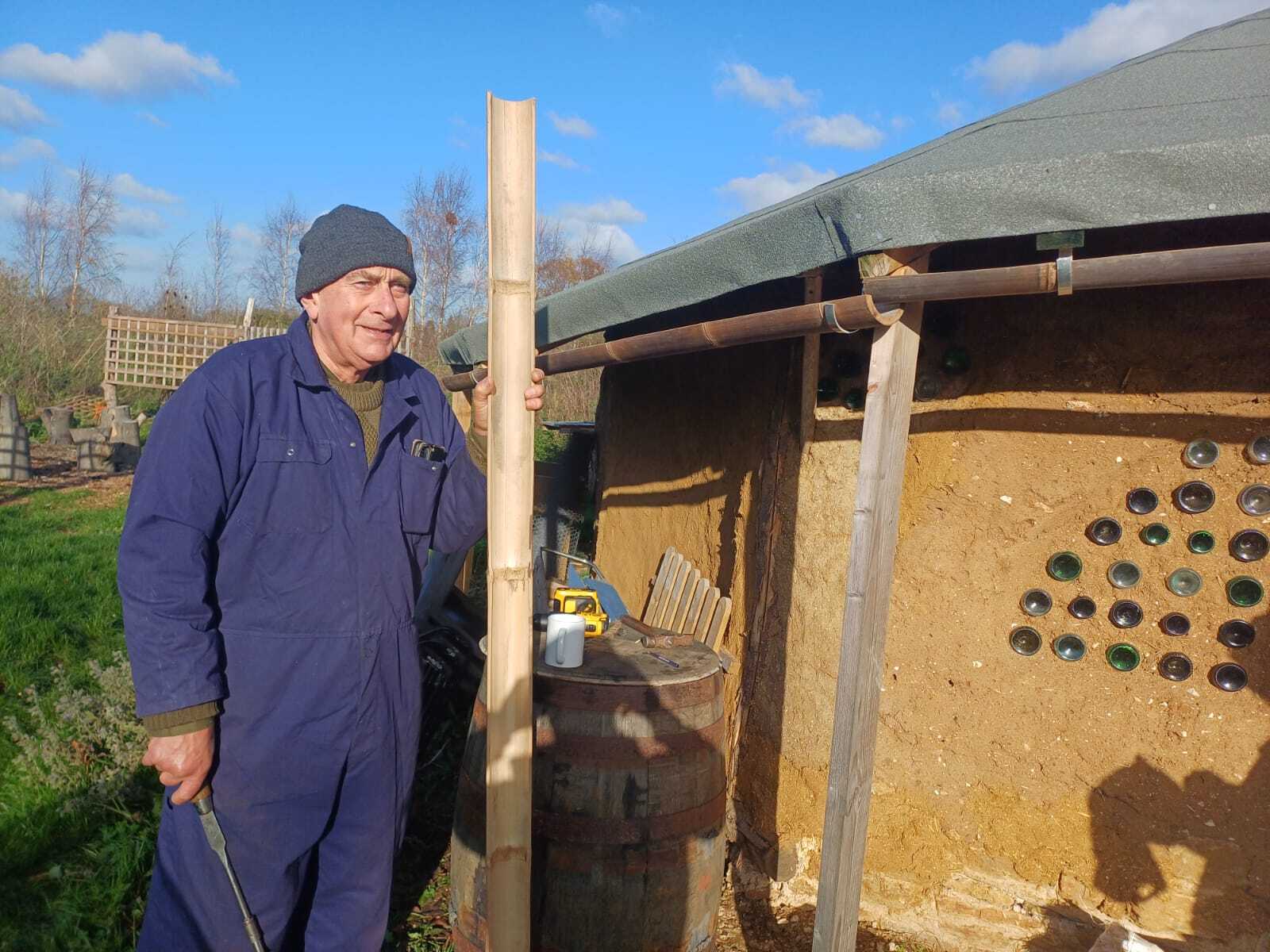
We have now begun work on the bamboo gutters at the Hub, and we’ve been fortunate to meet Malcolm, who has offered to assist with the project. Malcolm has kindly donated his time and some metal he had to design the brackets for the bamboo gutters. It’s looking great so far and the whiskey barrel water butts are a really lovely addition to the build.
Cobbing will resume in the Spring, when things get a bit warmer, but we’re making steady progress on plugging the remaining gaps.
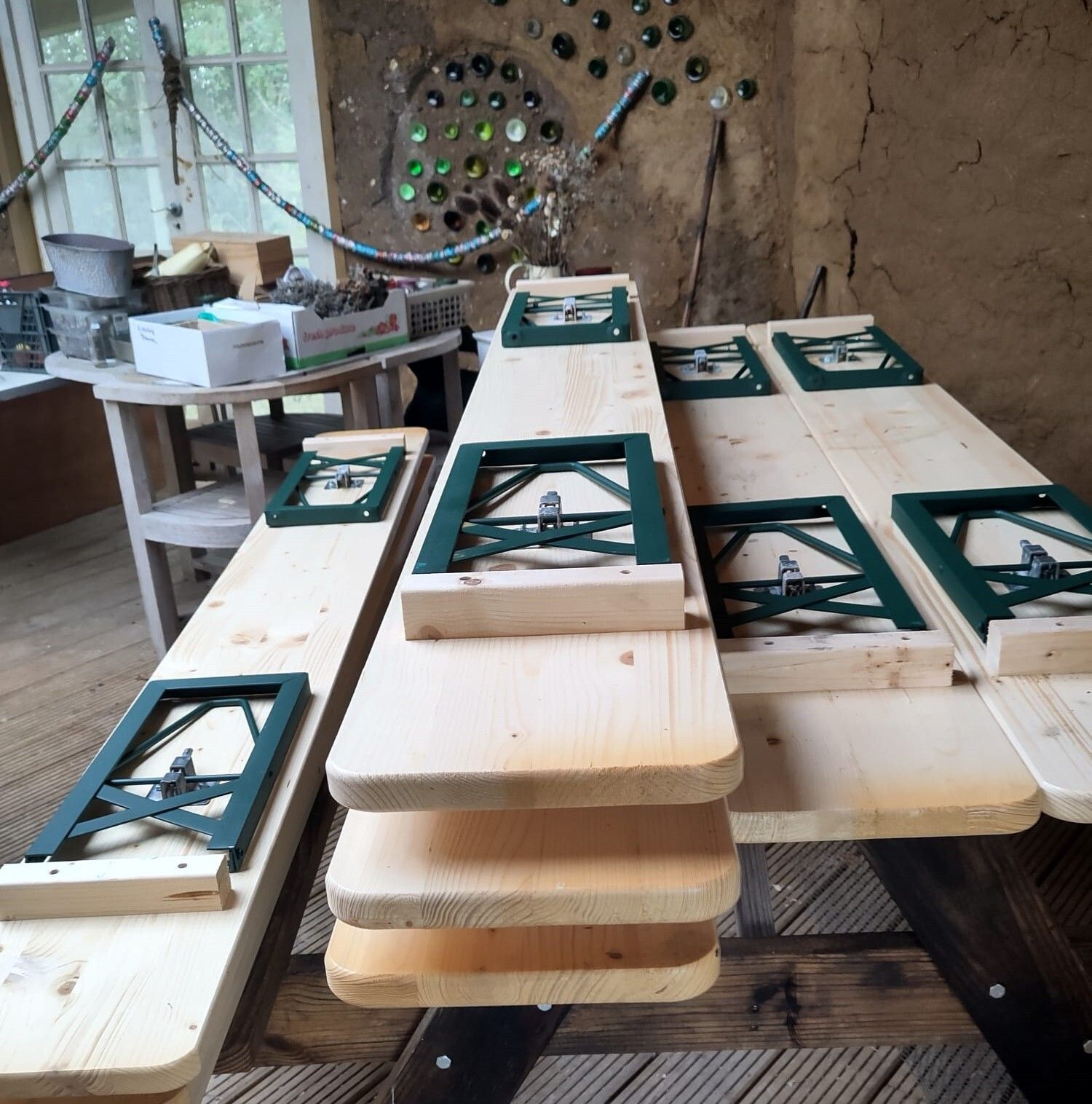
We’ve sourced some lovely folding benches and tables, which we’ll christen at the upcoming wreath workshop next Sunday.
Belties
The Belties are back to mow the meadows and the volunteers had a lovely day helping the Surrey Wildlife Trust team install the electric fencing around the grazing areas.
This year the “Lookerers” have been joined by new faces from Pewley Down volunteers, Mount volunteers and Zero Carbon Guildford, which means we have a great source of helpers and lots of backup.

☀️GROUPS AT THE GARDEN
The 6th formers from RGS and GHS have been enjoying tree-popping in the fields for their Tuesday sessions, and will be back next year to help at the garden.
The Growth Team from Surrey Choices have offered their time to come and tree-pop over the winter, so we’re really keeping on top of the blackthorn saplings to preserve the chalk habitat.
The hardy Guildford Spoon Carvers have pledged to do some carving days at the Hub throughout 2026, in addition to their regular monthly meetings. If you’re interested in spoon carving and bodging, drop them a line [email protected]
They welcome new members who have some experience and their own tools, or they can signpost novices to some great resources on how to start.
The children and staff from Pond Meadow School have started to come regularly to the garden, to volunteer and learn valuable life-skills before they go on to the next chapter. They’ve spent this month mulching around the fruit-trees with wood chip, and did a great job. One of the group leaders is our Erin, who works at the school, and she hopes to do some art and craft workshops in the Hub when the weather is bad.
🎯GARDEN PLANS FOR 2026
Build outside kitchen for Hub
Plant up the bog garden
Make another dead hedge near the pond
Finish the Hub
Look at funding for paid roles at the garden
🌧️RAINWATER COLLECTION RESEARCHERS
by Lisa Dittmar
In November, a group of Industrial Design students from Imperial came up to the garden as part of their research on rainwater collection in community gardens. They are working on some brilliant designs for asthetic and functional rainwater harvesting and will share the outcomes of their research, so stay tuned for future updates!

Here's what they had to say about their visit:
Everything from the toilets surrounded by water absorbing plants, to the rainwater harvesting set-up, to the central indoor community hub felt so considered and purpose driven. It was really clear how much effort, creativity, and collaboration you and the other volunteers have poured into creating a space that is functional and nurturing for the community. We left feeling energised, impressed, and honestly quite moved by what the garden represents.
🌱FAMILY NATURE SESSION WITH THE JOLLIES AND JANE

Daniel enjoyed some icy play in the fabulous new mud kitchen created by his dad, Paul. We then visited the Belties in the meadow, and afterwards took a stroll along the footpath next to the garden to enjoy the opening of the new Pewley View and some Beltie Biscuits!
Join Jane again on Saturday, 13 December from 1pm to 2pm. Wrap up warm and wear sturdy shoes » BOOK
💧A NEW BOG AREA AT ROSAMUND
by Margaret Hattersley

There are several ponds at Rosamund, which we hope will create a mosaic of habitats because they are at different stages of life and different depths and sizes.
The old pond is adjacent to the new pond and recently a team of volunteers cut back some of the surrounding vegetation to open an area around one side of it. It is now filling in a little, and we plan to introduce some semi-aquatic plants here to create a more diverse marsh habitat. We will plant native plants in the shallows such as marsh marigold, which flowers early providing nectar for bees, brooklime, marshmallow, and globeflower.
In the edge between the two ponds, we will introduce pillwort which will form a dense carpet around the margins of the larger pond over the coir netting.
In the deeper areas plants will include water forget me not which newts lay their eggs on, water mint which feeds butterflies, and bogbean which dragonfly nymphs climb up before molting into adult dragonflies.
90% of wetlands have been lost in the UK over the last 50 years. Marshland is not necessarily a natural habitat at the top of chalk downs (although areas of natural clay do create pockets of wetland), but by creating a small area here it’s helping to link wildlife corridors between sites for invertebrates, birds and amphibians.
The area is fed by rainwater collected from the roof of the compost toilet, so will remain damper than surrounding areas.
We will keep you posted on when the date for planting is planned next Spring!
🌱PLANT OF THE MONTH - MISTLETOE
by Helen Harris
Latin name: Viscum album (can translate as white goo!)
Common name: Churchman’s Greeting, Kiss-and-go, Masslin, Misle and Mislin-Bush.
Habitat: Native to the UK, lives in the canopies of broadleaf trees and apple trees. Mistletoe is relatively common but declining as more and more established orchards are cut down. With climate change it is thought to be on the move from its traditional counties on the English Welsh border and in the South of England. The Tree Council is running a citizen science project to try and get more data on this. You can take part here:

Appearance: Oval, evergreen leaves which grow in pairs; small, white flowers (February – April) made up of four tiny petals, in clusters; waxy, white berries in clusters of two to six. Seeds are coated in a sticky substance which sticks to the beaks of birds feeding on the fruit.
Mistletoe is dioecious meaning male and female flowers are produced on separate plants. It grows in spherical mass up to 1m across. All parts of the plant are poisonous to people.
Ecology: Mistletoe is hemi-parasitic: it attaches itself to the branches of host trees—most commonly apple, poplar, lime, and hawthorn—and draws water and nutrients while also photosynthesising for itself. Its presence is a sign of a healthy, mature orchard or woodland.
Mistletoe’s berries ripen over winter, providing a vital food source for birds such as the mistle thrush, redwing, fieldfare and woodpeckers. These birds are essential for mistletoe’s reproduction: distributing the sticky seeds on their beaks, feet and in their poo. Once on a branch, the gluey pulp around the seed hardens and fastens the seed in place. As the new mistletoe plant grows, the roots penetrate the bark.
Folklore, Traditions and Uses : Ancient Druids considered mistletoe sacred, especially when found on oak trees—a rare occurrence. It was believed mistletoe possessed mystical powers, symbolising life and fertility due to its ability to thrive in the winter months. Mistletoe was used in rituals for protection, healing, and to bring good luck.
The tradition of kissing under the mistletoe is thought to have originated in the 18th century. According to custom, a berry should be picked from the sprig with each kiss. This practice is said to bring romance, luck, and harmony during the festive season.
Mistletoe contains an anti-spasmodic compound and is said to be useful in the treatment of epilepsy.
Sources:
NBN
Plantlife
Woodlandtrust
Wishing you all a lovely festive break and hopefully see some of you on the 20th for a cuppa and catch up.
From the Rosamund Team
🎟️JOINING INFO
Please visit https://www.guildfordcommunitygarden.org.uk/
Reply